
When the World Changed and the Fynbos Was Born: How the Last Great Climate Shift Forged the “Fine Bush”
Across the wind-burnished ridges of South Africa’s southwestern Cape lies one of Earth’s most astonishing landscapes. The locals call it “fynbos” — from the Dutch “fijn bosch”, meaning “fine bush”.
From a distance, it can appear muted: a wash of olive, bronze, and grey-green shrubs stretching across rocky slopes. But look closer and it bursts into life — thousands of miniature species, each perfectly tuned to a rhythm of fire, wind, and water. The fynbos holds more plant species than the entire United Kingdom, packed into a strip of land smaller than Portugal. It is, quite literally, one of the richest pieces of Earth’s botanical real estate.
Yet this beauty was born of upheaval. The fynbos exists because the world changed — violently, irreversibly, and magnificently — three million years ago.
A Warmer Earth Before the Fynbos
For most of the last 20 million years, the world was a warm, humid place. The Miocene and early Pliocene epochs were marked by forests stretching across continents. Southern Africa, too, was lush — home to subtropical woodlands and riverine forests nourished by steady rainfall throughout the year.
The ancestors of today’s fynbos plants lived quietly on the margins — clinging to nutrient-poor slopes where trees couldn’t outcompete them. The Benguela Current along the west coast of Africa existed, but it was weak and seasonal, bringing only gentle pulses of cold water. Warm seas and mild air meant a relatively uniform, forgiving climate.
But beneath the calm, tectonic forces were rearranging continents and redirecting oceans.
The Day the Oceans Changed Direction
Starting five million years ago, a narrow strip of land rose between North and South America — the Isthmus of Panama. It was a small geological bridge, but it transformed the planet’s climate machinery.
Before the isthmus formed, the Atlantic and Pacific Oceans exchanged warm, low-salinity waters across the equator. Once that seaway closed, the Atlantic became saltier and heavier. This density difference supercharged the Atlantic Meridional Overturning Circulation (AMOC) — the deep conveyor belt that carries warm water northward and cold water southward.
The knock-on effects were enormous.
The Northern Hemisphere warmed, increasing evaporation and precipitation at high latitudes. Paradoxically, this led to the growth of snow and ice, as moisture condensed and froze in cooler regions. The Hadley Cells — giant loops of atmospheric circulation — strengthened and shifted, while subtropical high-pressure belts expanded. Rain belts retreated toward the equator, and the mid-latitudes, including southern Africa, began to dry.
The world that had favoured forests was gone. In its place came the era of seasonality.
The Awakening of the Benguela
On the west coast of southern Africa, the consequences were dramatic. The intensified subtropical high-pressure system over the South Atlantic increased offshore winds, which in turn strengthened coastal upwelling. Cold, nutrient-rich water surged to the surface. The Benguela Current — now one of the world’s great oceanic systems — began to dominate.
Sea-surface temperatures off the Cape plummeted by several degrees. The overlying air cooled and stabilised, suppressing cloud formation and summer rainfall. At the same time, the South Atlantic High settled into a more permanent summer position, creating long, dry, cloudless months.
In winter, as the pressure belt shifted northward, frontal systems from the westerlies swept over the Cape, bringing cool rain.
This new rhythm — wet winters, dry summers — defined a new kind of climate: “Mediterranean”. Only five regions on Earth would develop it, and each would give rise to extraordinary biodiversity. The Cape was one of them.

A New Landscape, a New Challenge
The establishment of Mediterranean seasonality between five and three million years ago was more than a climate event; it was an ecological reset.
The lush, even-tempered woodlands that had thrived on year-round rain began to vanish. Prolonged summer droughts killed moisture-loving trees, while winter rains, though reliable, arrived when temperatures were too low for rapid growth. Fire, once a rare disturbance, became frequent and fierce.
Soils, already ancient, grew poorer. On the quartzitic sandstones and shales of the Cape Fold Belt, nutrients had been leached away over hundreds of millions of years. What remained was a matrix of sand and silica — low in nitrogen and phosphorus, acidic, and hostile to most plants.
And yet, where others faltered, this “fine bush” began to flourish.
The Breakthrough: The Ericoid Leaf
Among the first to seize this opportunity were the ericoid plants — those with small, narrow, rolled leaves resembling the heaths (Erica) that now blanket Cape mountainsides.
The ericoid leaf was the evolutionary breakthrough that allowed life to bridge the new climatic divide between Mediterranean winters and summers.
Each leaf is a miracle of miniaturisation:
Fine and rolled: The tiny, needle-like shape drastically reduces surface area, limiting water loss during the long, hot summers.
Waxy armour: A thick, glossy cuticle reflects sunlight and prevents dehydration.
Sunken pores: Stomata, the breathing pores that allow gas exchange, are recessed into grooves — protected from the dry wind.
Trapping humidity: Fine hairs on the surface create a microscopic layer of still, moist air, recycling each molecule of water again and again.
Longevity: These leaves live for years, not months, conserving nutrients in tissues rather than shedding them seasonally.
One of the fynbos’s most ingenious adaptations; the ericoid leaf’s minute, rolled form hides a subtle water-saving design. The leaf surface is often covered with fine hairs that trap a thin layer of moist air around it — a self-made microclimate. Within this protected film, the air stays humid even when the surrounding atmosphere is dry.
This allows the plant’s stomata — the tiny pores through which it breathes and photosynthesises — to remain open longer without losing precious water. While most plants must close their stomata in heat or drought, halting photosynthesis to prevent dehydration, ericoid leaves keep working steadily. In effect, each leaf becomes its own miniature greenhouse: conserving moisture, moderating temperature, and sustaining life when the Cape summer turns searing.
Nutrient Alchemy: Surviving on Starvation Soils
Equally vital was the ericoid root system. On the impoverished, quartzitic soils of the Cape, roots alone could not access enough nutrients. Instead, ericoid plants formed mycorrhizal partnerships — microscopic alliances with soil fungi.
These fungi break down organic matter and even rock surfaces, releasing nutrients that the plant absorbs through its fine root hairs. The plant, in return, supplies the fungi with sugars from photosynthesis. This elegant exchange allowed fynbos plants to thrive where most vegetation would starve.
It also explains the tannin-rich, slow-decaying litter that covers fynbos slopes. By decomposing slowly, this litter locks up nutrients, preventing them from being washed away by rain. The system recycles everything within itself — an economy of scarcity perfected over millennia.
Fire: The Sculptor of Fynbos
Fire completed the fynbos equation.
As summers grew longer and hotter, lightning and dry winds sparked frequent fires. For plants adapted to this cycle, fire was not destruction — it was renewal.
Many fynbos plants store seeds in fire-proof capsules or woody cones, which open only after exposure to heat or smoke. Others resprout from underground lignotubers, their buds safely insulated below the surface. Some even use the ash as a nutrient source, germinating only when the soil is enriched by fire.
Each fire creates a fresh canvas. Young, fast-growing species colonise first; slower, longer-lived shrubs follow. Within a few years, a mosaic of ages and species emerges, each patch a snapshot of regeneration at a different stage. Over time, this cycle of fire and rebirth created an ecosystem of astonishing complexity — and resilience.
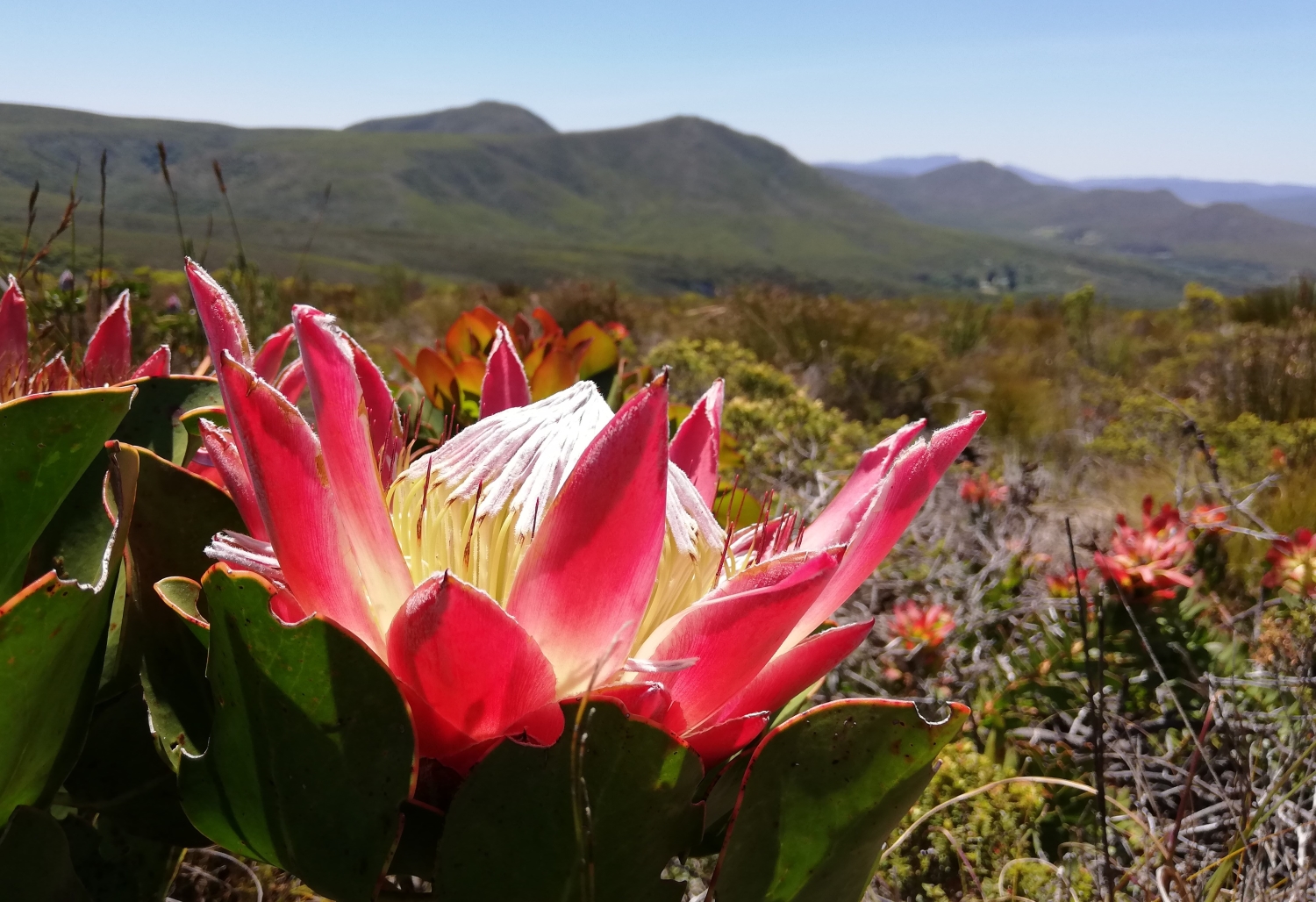
Evolution in Overdrive
The rocks that underpin the Cape Fold Belt — mainly quartzitic sandstones, shales, and granites — are ancient, some over 500 million years old. Since the last major mountain-building episode (the folding of the Cape Supergroup during the late Paleozoic, around 250–300 million years ago), the region has experienced no significant tectonic upheaval or volcanic activity.
With its patchwork of mountains, valleys, and microclimates, the Cape provided endless opportunities for isolation and innovation. Populations separated by a single ridge could evolve independently, adapting to subtle differences in temperature, rainfall, and soil chemistry.
This is why the Cape Floristic Region — covering less than 0.022% of the world’s land area — contains nearly 3% of its plant species. More than 9,000 species thrive here, two-thirds found nowhere else on Earth.
Most of them trace their success to the same ancestral blueprint: fine leaves, advanced mycorrhizal root relationships, and an unyielding tolerance for fire, drought, and poverty.
The fynbos became a living library of evolution — every plant a page in a story written by climate change.
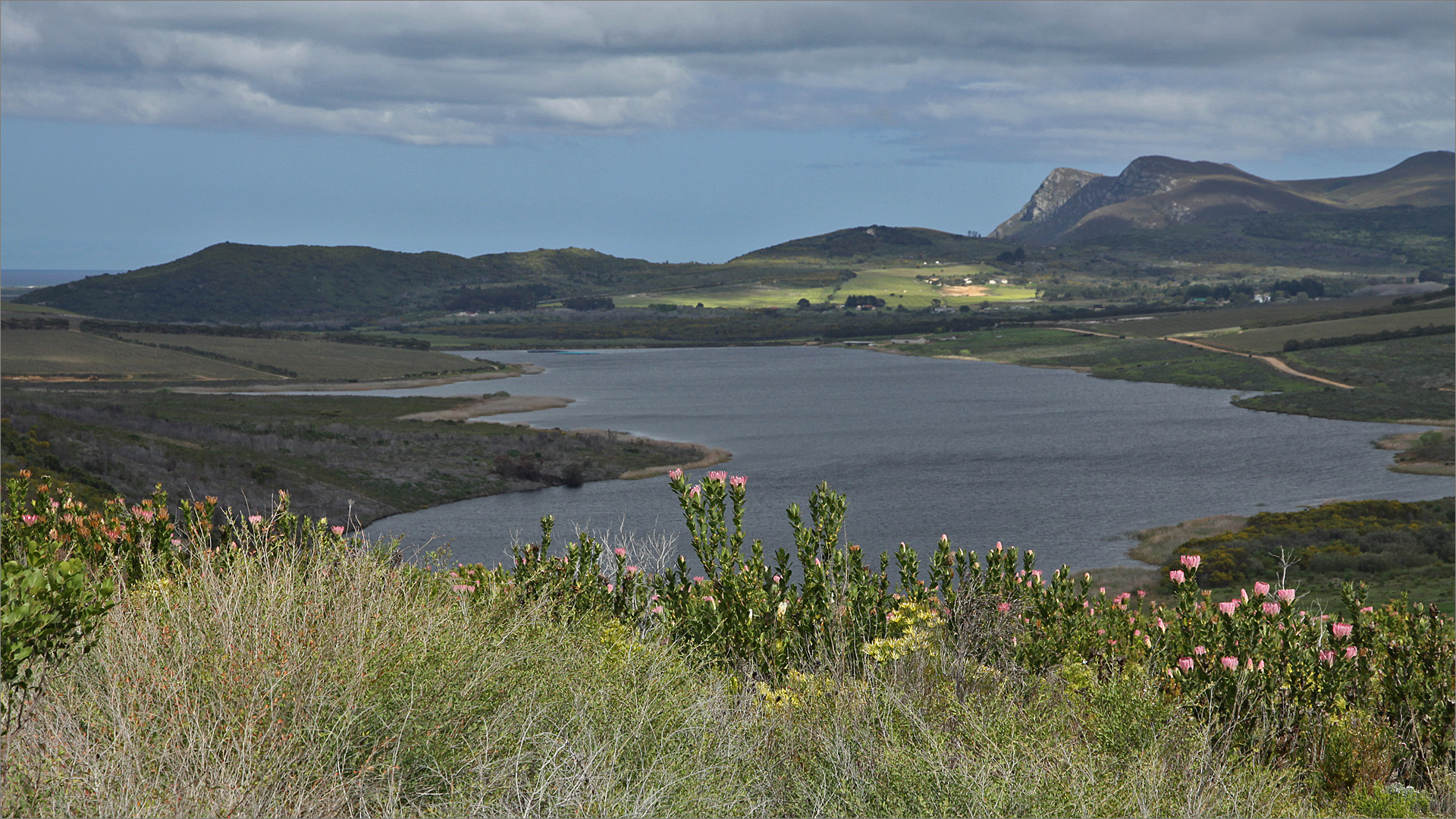
The Modern Legacy: Protecting Fynbos at Lomond.
Today, the fynbos still dances to its ancient rhythm — rain in winter, drought in summer, renewal through fire. But the threats have changed. Urban expansion, invasive species, and shifting climate patterns now test this ancient system in new ways.
Fortunately, a network of conservationists, scientists, and land stewards has risen to meet that challenge. Among them is Lomond Wine Estate, near Gansbaai, a member of the Walker Bay Fynbos Conservancy.
Lomond has set aside over 800 hectares of fynbos as protected area, home to rare vegetation types like Elim Ferricrete Fynbos and Overberg Sandstone Fynbos. Working with WWF South Africa, Lomond was named a Conservation Champion, recognising its leadership in sustainable agriculture and biodiversity protection.
In partnership with Fauna & Flora International, Lomond also pioneered South Africa’s first conservation servitude on a wine estate — a permanent legal safeguard ensuring these fynbos habitats remain untouched for generations.
Visitors to Lomond can walk among the same ericoid shrubs that once responded to global climate upheaval — plants whose fine leaves and hidden roots continue to embody the art of endurance.
The Lesson in Fynbos
The fynbos is more than a landscape; it’s a testament to adaptation. It reminds us that life’s greatest achievements often emerge not in times of comfort, but in moments of upheaval.
When the world’s oceans changed course and the climate turned harsh, plants here did not retreat. They reinvented themselves — crafting fine, resilient leaves that could photosynthesise in winter, sleep through the summer, and rise again after fire.
Every slope of the Cape still carries that story. It’s whispered in the scent of Buchu, in the shimmer of restios in the wind, in the ash that feeds new green shoots.
Fynbos endures not because it resists change, but because it evolved with it— and in doing so, it became one of the planet’s most eloquent symbols of resilience.